The EU REACH Compliance Checklist for 2026
A REACH compliance checklist is only useful if it shows what actually happens when a substance meets a regulator. Most online checklists only tell you to “register your substances which is not very helpful.
We wanted to make a more practical guide which shows the exact steps we go through with manufacturers and importers before registration starts, and highlights the common mistakes companies make. By the end, you will know your obligations, the correct order of steps, and what it means to be “compliant” in 2026.
REACH is the EU regulation for the Registration, Evaluation, Authorisation and Restriction of Chemicals, Regulation (EC) No 1907/2006, and applies to all kinds of companies, not just chemical manufacturers. If your products contain substances on their own, in mixtures, or in articles, you are probably in the scope of REACH. The checklist below covers all the steps and our regulatory experts are here to help you with our extensive REACH compliance consulting service.
Before you start: confirm your role under REACH
Your obligations not only depend on what you sell. They also depend on which role you have in the supply chain. Among the first things we need to know about our clients is not just “what is your product” but “who are you under REACH,” because the same shipment of the same chemical creates completely different duties depending on the answer.
REACH defines four roles:
- Manufacturer: an EU/EEA-based company that produces a substance within the EU territory
- Importer: an EU/EEA-based company that brings a substance, mixture, or article into the EU customs territory.
- Downstream user: an EU/EEA-based company that uses a substance in the course of industrial or professional activities.
- Only Representative (OR): an EU/EEA-established entity appointed by a non-EU manufacturer, under Article 8, to carry the registration obligations that would otherwise fall on the EU/EEA importers.
A non-EU/EEA manufacturer or formulator cannot register directly with the European Chemicals Agency (ECHA). They must either appoint an Only Representative (OR) or let each EU importer register on their own. The second option splits your data, increases costs, and reduces your control. Solve this question first, because your REACH duties may change depending on the answer.
EU Chemical Regulatory Compliance
Substance inventory
REACH registration
SVHC screening
Compliant SDS
Retained records
REACH compliance is continuous, not a one-time submission. Re-scan the SVHC Candidate List and the regulatory annexes at every update. A substance can move out of compliance with no change on your side.
Based on Regulation (EC) No 1907/2006 (REACH)
Phase 1, Scope – confirm what REACH actually covers in your business
You cannot comply with an obligation you have not identified. Phase 1 is about making a list of the key factors.
- List every substance you manufacture or import: on its own, in mixtures, and contained in articles.
- Confirm annual tonnage per legal entity. The 1 tonne-per-year threshold triggers registration: tonnage is calculated per legal entity per calendar year, not per shipment or per product line.
- Identify exemptions. Substances in Annexes IV and V, certain on-site isolated intermediates, and substances used in product and process-oriented research and development (PPORD) may be exempt from certain requirements or have fewer duties.
- Check existing registration status: most substances are already covered by a joint submission you will need to join rather than starting a completely new individual submission.
An important exception to note is that polymers are exempt from registration, but monomers and other chemicals used to make them are not. “We only make polymers, so REACH does not apply” is one of the most common misunderstandings.
We helped numerous companies that had initially used an incorrect substance identification number when preparing for REACH registration. Our experts developed an assessment plan that included all necessary verification steps to confirm the correct substance identification number. An incorrect substance ID can invalidate a REACH registration and expose a company to significant legal and compliance risks under the REACH Regulation.
Phase 2, Registration: making the substance legal to place on the market
- Compile and submit an inquiry dossier to ECHA for any substance, to confirm the substance identity and find the joint submission.
- Join the joint submission, agree on data sharing, pay and obtain a Letter of Access from the lead registrant or consortium.
- Compile and submit the registration dossier to ECHA and pay the ECHA registration fee for your tonnage band.
- Respond to ECHA’s completeness check and any subsequent evaluation requests within the deadlines given.
Registration is the stage where small early mistakes can later on lead to bigger problems and costs. . An incorrectly calculated tonnage band, an incomplete substance identity profile, or a missing endpoint does not just delay the dossier. It can mean going back to data assessment that was supposed to be completed.
We have frequently encountered cases where companies have misunderstood the data requirements for REACH registration. Many believed that documents such as Safety data sheets (SDS), Certificates of analysis (CoA), SVHC certificates, or self-declarations were sufficient to demonstrate the chemical composition of the substance. Our experts evaluated the available information, identified the missing data, planned, arranged, and managed the necessary laboratory testing to generate REACH-compliant data and reports.
Phase 3: SVHCs, restrictions, and authorization
Registration makes a substance legal to be placed on the market, but only for specific uses. Phase 3 is the part companies most often miss.
- Screen every substance against the SVHC Candidate List of substances of very high concern.
- If you supply articles containing an SVHC above 0.1% weight-by-weight: provide Article 33 information to recipients and consumers, submit an Article 7(2) notification to ECHA where thresholds are met, and file a SCIP notification to ECHA’s database.
- Check Annex XIV, the Authorization List. Substances on it cannot be used after their sunset date without a granted authorization.
- Check Annex XVII, the Restrictions list, for restricted substances, uses, and concentration limits.
The Candidate List is updated roughly twice a year. A substance that was not an SVHC when you registered it can become an SVHC even though there is no change in your product’s composition, which is why Phase 3 is not a one-time task but must be checked regularly, which we will go through in Phase 5.
Phase 4: Communication and documentation
The REACH regulation is largely about communicating information on chemicals. The data must travel down the supply chain through the correct documents.
- Compile or update Safety Data Sheets (SDS) according to Annex II format requirements for every hazardous substance and mixture.
- Attach exposure scenarios as an extended SDS for substances supplied at 10 tonnes per year or more that require a Chemical Safety Report.
- For hazardous mixtures, complete the Poison Centre Notification (PCN) and display the UFI code on the label.
- Keep every SDS aligned with the registered dossier: the SDS must never claim the content that the registration dossier does not support.
This is where most non-compliance is actually found, because the SDS is the document your customers and the inspecting authority actually read. An outdated SDS can be an immediate indicator of potential non-compliance, regardless of how complete the registration dossier is.
Phase 5, Ongoing compliance: the step that “checklists” often miss
A checklist implies a finish line. REACH duties do not have that. Once a substance is registered, REACH obligations continue for as long as you place the substance on the market.
- Update your registration whenever your tonnage band changes, a new use is identified, or the substance composition changes etc.
- Re-scan the Candidate List and Annexes XIV and XVII at every update.
- Track annual manufacture and import volumes per substance, per legal entity.
- Retain all REACH information for at least 10 years after you last manufactured, imported, or supplied the substance.
- Re-confirm that downstream uses are covered by your exposure scenarios.
What changes for REACH compliance in 2026
Three things make the 2026 checklist different from the 2024 one.
The revision of REACH itself continues to move through the EU legislative process, with proposed changes to registration data requirements, the treatment of polymers, and supply-chain communication among the areas under discussion.
The new CLP hazard classes introduced by the 2023 amendment to the CLP Regulation, covering endocrine disruptors and the persistent, bioaccumulative, toxic and mobile categories, are reaching their transitional application dates. That means reclassification work and corresponding SDS and label updates for affected substances.
One scope note: this checklist covers EU REACH only. UK REACH is a separate regime with its own registration system and deadlines, and it is not addressed here.
The mistakes we see most often
Four patterns account for most of the non-compliance we are called in to fix. Knowing them is itself a checklist item.
- Assuming the importer “handles REACH.” Many non-EU companies treat REACH as their EU customer’s issue. It works until an importer changes, deregisters, or simply does not register at all, and market access disappears with them.
- Misreading the tonnage band. Tonnage drives the fee, the data requirements, and whether a Chemical Safety Report is needed. When the tonnage band is confirmed late, the dossier may need to be reopened, reassessed and resubmitted.
- Treating the SDS as a formatting task. The SDS is a regulatory document, not a template. When its content is inconsistent with the registered data, it becomes the easiest non-compliance for an inspector to find.
- Forgetting that the Candidate List is regularly updated. Compliance confirmed in January may no longer apply in June even if the company has made no changes in the product’s formulation.
A quick summary of the REACH compliance checklist
Here is a quick recap of the checklist, for which you can check the details described in the phases above.
- Confirm your role: EU/EEA manufacturer, EU/EEA importer, EU/EEA downstream user, or Only Representative.
- Inventory every substance, on its own, in mixtures, and in articles.
- Confirm tonnage per legal entity per year;
- Identify exemptions.
- Evaluate and obtain all required data for substance identification
- Compile and submit the Inquiry dossier, check ECHA assessment outcome on Joint submission and proceed with Letter of Access agreement and payment with the Consortium
- Compile and submit the Registration dossier; pay the ECHA registration fee; check ECHA assessment outcome on the registration
- Screen against the SVHC Candidate List, handle SCIP and Article 33 and 7(2) duties.
- Check Annex XIV (authorization list) and Annex XVII (restriction list).
- Compile and align SDS, exposure scenarios and PCN (if applicable).
- Maintain registrations, monitor user lists, track volumes, retain records for 10 years.
- Re-check after every Candidate List update and regulatory change.
Frequently asked questions
Who needs to comply with REACH?
Any EU/EEA company that manufactures or imports a substance into the EU at one tonne or more per year, on its own or in a mixture, is in scope. REACH also applies to EU/EEA producers and importers of articles that contain substances intended to be released. EU/EEA downstream users have their own, lighter set of obligations. Non-EU manufacturers and formulators cannot register directly and must appoint an Only Representative to handle on their behalf
Is there an official REACH compliance checklist?
ECHA publishes detailed guidance for each obligation, but there is no single official “checklist” document that covers the regulation end to end. The checklist above is structured to follow ECHA’s process while staying readable for a non-specialist.
How often should I review REACH compliance?
At minimum, review at every SVHC Candidate List update, which happens roughly twice a year, and whenever your tonnage, uses, or substance composition change. Compliance is a continuing obligation, not a one-time task.
What happens if I am not REACH compliant?
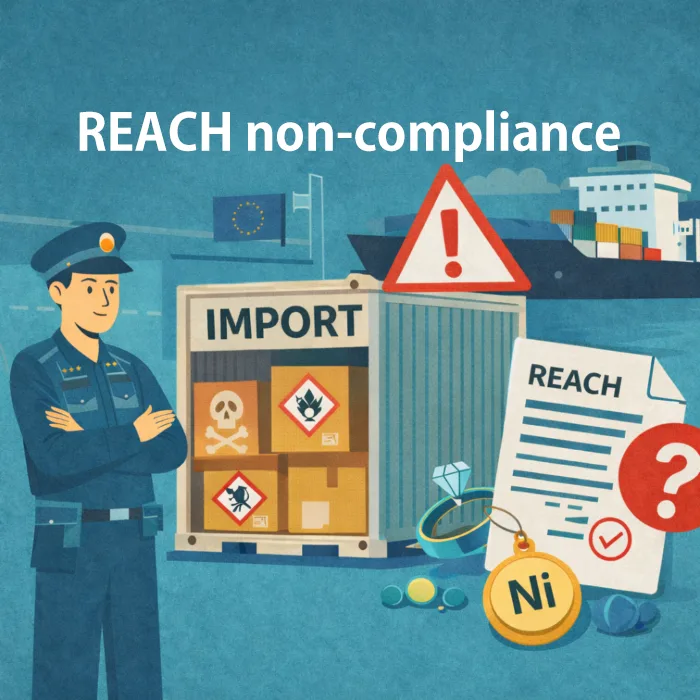
Non-compliance can lead to customs refusing entry to imported chemicals, enforcement action and financial penalties by national authorities, and loss of trust along your supply chain. The earlier a gap is identified, the more options remain to fix it without losing market access.
Where this leaves you
A checklist tells you where you stand. It does not, on its own, move a substance through ECHA. If you have worked through the five phases and identified gaps (an unconfirmed tonnage band, an outdated SDS, an SVHC you had not screened for), those gaps are the work, and they rarely fix themselves.
That is the point at which it is worth a conversation. You can speak to our REACH team about a scoping review, or request a free initial consultation and we will assess the case with you. Chementors has handled EU chemical compliance since 2012, with 150+ completed REACH registrations, so the steps on this page are not theory. They are the actual tasks.